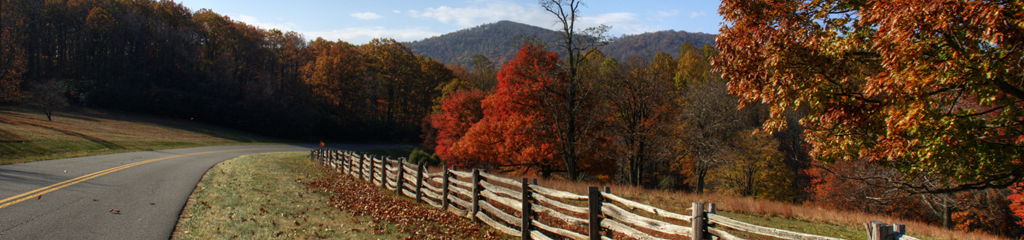
This site is in the process of being grown. As I spend time learning about the Pennsylvania Mountains I’ll be sharing my thoughts and discoveries, my old blogging friends and new acquaintances, my general sense of wonder at everything having anything to do with the mountains of Pennsylvania. If I sometimes wander into areas of Pennsylvania that you don’t consider mountainous, bear my upbringing in mind…We don’t have many hills even on the Texas Gulf Coast where I was reared.
If you like the concept or wish to add anything to the site, please leave a comment and let me know what changes you would like to see.
In the meantime, since you are already here, wander around and kick the tires, check the closets, poke into the corners…Enjoy your stay.
North-to-northwest view of Pleasant Valley from Lookout Rocks, Appalachian Trail, Monroe County. The ridgeline in the distance is the Pocono Plateau. Uploaded by Nicholas_T on 15 Sep 07, 9.00PM CDT.
I stumbled across Nicholas_T on Flickr as I was looking for some shots of the Pennsylvania Mountains to use in some new headers I was working on. His gorgeous photos are like taking a tour of the Pennsylvania Mountains on the perfect day…All year long.
Go…spend some time looking at his photostream. Do it as a slideshow…It is just beautiful…
This past week I have been spending my time studying online, going over maps, and reading the reference books I have on hand trying to settle on an area of coverage for this site.
I started out with a Physiographic Map of Pennsylvania I downloaded(1). I tried to overlay that with a Pennsylvania Tourism & Transportation Map I received from the state last year. Then I went to the Visit Pennsylvania site and tried to figure out their regional distribution. Finally I ended up studying the Longstreet Highroad Guide To The Pennsylvania Mountains by Greg and Karen Czarnecki(2). It was the first map and the guide that I decided to use to decide my editorial coverage.
Overview
Pennsylvania is divided into six or seven major physiographic provinces (depending on source, the map has six the book has seven). Of these provinces only three contain mountain areas. The majority of the state is located in the Appalachian Plateau. This province is divided into ten regions, not all of which contain mountains. The next province is the Valley and Ridge Province that arcs across the center part of the state. The final mountain province is the Blue Ridge Province which has its northern most presence here covers just portions of three counties.
The mountains of Pennsylvania are blessed with a forest ecosystem. While the original settlers to these mountains would not recognize these as the forests they were familiar with, the coverage is almost as great as the virgin forest of three centuries ago. Trees dominate much of the topography of these mountains today…Valleys, mountaintops and plateaus are all tree covered again today after having been stripped of their growth during the first two centuries of settlement by European settlers.
The Provinces and the Counties
Appalachian Plateaus Province – The largest of the physiographic provinces is divided into six sections, two of which do not fall within the mountain region. The four sections we will be are:
Allegheny Mountain Section – Cut by numerous streams feeding the three major rivers that flow into the Ohio River, this section rises from west to east. Where the rivers cross the ridges at the east end of the province they have cut deep, spectacular water gaps. Some of these gaps are over 1000 feet deep. This region, as with most of the state, was almost completely logged over in the nineteenth century. The highest point in Pennsylvania lies here at Mount Davis on Negro Mountain. This section contains all or part of the following counties:
Centre County
Blair County
Clearfield County
Cambria County
Indiana County
Westmoreland County
Somerset County
Fayette County
Allegheny High Plateau Section – This is the highest section in the Appalachian Plateau Province. Mostly forested, sparsely settled…The highest point in this section is a triple divide at 2,560 feet is the meeting place of three watersheds. Rain falling at this place in Potter County flows either into the Atlantic, the Gulf of Mexico or the Great Lakes. This section contains all or part of the following counties:
Warren County
Forest County
Venango County
Clarion County
Jefferson County
Elk County
McKean County
Cameron County
Clearfield County
Centre County
Clinton County
Potter County
Tioga County
Lycoming County
Pocono Mountain Section – This section is predominantly gently rolling hills with a relative elevation of just about 300 feet (overall elevations range from 1,300 to 1640 feet). This area is best known for its vacation and recreation areas. This section contains all or part of the following counties:
Pike County
Monroe County
Wayne County
Lackawanna County
Luzerne County
Glaciated Low Plateau – This mostly wooded region was shaped by glaciation. Glaciation created a varied topography with swamps, bogs and lakes being common. With elevations ranging from 754 feet on the Susquehanna River to the eastern edge at 2,300 feet where the ridges continue on into New York as the Catskill Mountains. This section contains all or part of the following counties:
Tioga County
Bradford County
Susquehanna County
Wyoming County
Wayne County
Pike County
Monroe County
Lackawanna County
Valley and Ridge Province – Containing some of the most dramatic scenery in Pennsylvania, this province flows as a series of parallel ridges from the Maryland border on the south to the New Jersey border on the east and covers almost a quarter of the state. This province is divided into two sections; the Appalachian Mountain Section and the Great Valley section. This site will only cover the Appalachian Mountain Section, this section contains all or part of the following counties:
Appalachian Mountain Section
Bedford County
Fulton County
Franklin County
Blair County
Huntington County
Mifflin County
Juniata County
Perry County
Cumberland County
Centre County
Lycoming County
Clinton County
Montour County
Columbia County
Snyder County
Northumberland County
Dauphin County
Lebanon County
Schuylkill County
Luzerne County
Lackawanna County
Carbon County
Monroe County
Blue Ridge Province – One of the smallest provinces in Pennsylvania, this section of mountains only extends 40 miles north of the Maryland border and marks the end of the Blue Ridge that began in Georgia. In Pennsylvania this section is known as the South Mountain. This section contains all or part of the following counties:
Franklin County
Adams County
Cumberland County
Sources:
COMMONWEALTH OF PENNSYLVANIA; DEPARTMENT OF CONSERVATION AND NATURAL RESOURCES; BUREAU OF TOPOGRAPHIC AND GEOLOGIC SURVEY – www.dcnr.state.pa.us/topogeo
Washington, D.C.—According to a new assessment released today by the National Parks Conservation Association NPCA and the Appalachian Trail Conservancy ATC, one of the most beloved recreational footpaths in the United States, the Appalachian National Scenic Trail, faces many challenges that put the experience of visitors and trail resources at risk. Adjacent land development on privately owned land, sources of air pollution, and funding shortfalls impacts the ability of trail managers to protect historic structures and preserve trail resources.
“The Appalachian Trail attracts millions of hikers each year, and we must ensure its unique American experience is protected for future generations to enjoy,” said Ron Tipton, NPCA’s senior vice president of policy. “This report demonstrates clearly that a strong commitment by government agencies and trail advocates is essential to preserve the AT’s unique natural and cultural values for future generations.”
Dave and Beth Adams of Cassandra Pages talk about poetry and self-plagiarism. Dave reads his poem “Ode to a Chalk Line Reel”…
Ode to a Chalk Line Reel by Dave Bonta
The day after Bo Diddley died, I watched a carpenter stretch a line the length of a board & give it a pluck: a diddley bow with no resonator, dry chalk instead of a bottleneck slider’s glissando note. I’d been expecting blue, but this line was red. The saw followed shortly with its howling eraser.
I had an argument with the carpenter about new tools versus old. Why does something that works ever have to be replaced? Why red? Why plastic for the housing? Why the constant upgrading to new drills & saws? The carpenter showed me his hands: they were cruelly crippled. I can only use what fits my grip, he said.
That sudden, electric blue from my father’s chalk line was one of my favorite things. Inside the chrome-plated reel I pictured a Galilee of chalk where the string went to renew its glowing shadow, like a blueprint line translated from the plane of the ideal: fuzzy, but straight as a fault.
I find myself in the position of not knowing a lot about the Pennsylvania Mountains. In looking through my blogroll I was surprised by the few links I came across that were specific to this region. Here are a few folks living their Mountain Dreams…
From Roundtop Mountain
First there was this snippit from a few days back…
Snow dusted the mountain last evening, just enough to make walking slippery this morning. The new snow covers both ice and bare patches, so I can no longer tell one from the other. I step out smartly, only to slip and nearly fall when my boot finds the ice.
As cold as it has been for the past 10 days, I am surprised to still find some open water. The faster moving streams are still open and gurgling. ~ Roundtop Ruminations: Open water.
I have been reading Carolyn’s blog at Roundtop Ruminations for as long as I can remember. She helped identify one of my hawk photos a long time back and we travel in the same circle of blogs. She shares the sights, sounds, and feelings of living on the side of a mountain in SE Pennsylvania. Today she has posted a number of photos that are just beautiful…Roundtop Ruminations: An embarrassment of riches.
From Plummer’s Hollow
There is one other group of “bloggers” from Pennsylvania that I have followed for quite a while. They are the prolific Bonta’s of Plummer’s Hollow. I first began following Dave at via negativa, his site for poetry, nature observations, photography, video, and I am not sure how else you could categorize everything he does on the site…Here is today’s…
My sledding video from last winter was such a success, I thought I’d try it again this year. The conditions were pretty icy and scary last winter, so I stopped at the half-way point, not wanting to risk the video camera any farther. (I hold it in my right hand as I ride — this isn’t a helmet cam.) But this winter, given all the wonderful cold weather and regular snow, sledding conditions have been exceptional, and with the January thaw imminent, yesterday afternoon I went ahead and shot this video of a sled ride clear to the bottom, a mile-and-a-half-long run. It isn’t quite non-stop, as you’ll see: there are two places, slight uphills on the way down, where I had to get out and walk for a few yards. (The first is the half-way spot where I stopped in last winter’s video.) ~ Sledding Plummer’s Hollow | Via Negativa.
Even though it would probably be my death…I’d love to make that ride down the mountain like Dave…Growing up in Texas, I have never seen snow on a hill that could be rode. I’d break my neck fersure.
Dave’s mother, Marcia Bonta, is a much published naturalist author. Her site contains many of her articles and links to other interesting sites. I want to thank her for the knowledge she shares about the natural world outside her door…Here is a sample of her latest…
The Iroquois called it the “Tree of Great Peace.” Its cluster of five needles to a bundle represented the five nations of the Iroquois and its spreading roots, reaching east, north, west, and south were the roots of peace that extended to all peoples.
We call this tree, more prosaically, eastern white pine — Pinus strobus — meaning “gum-yielding pine tree,” and “white” referring to its light-colored wood. It’s also been called sapling, pumpkin, soft, northern, and Weymouth pine, the latter name a tribute to Thomas Viscount Weymouth who, in 1605, had eastern white pine planted on his Longleat estate in England.
Do yourself a favor, if you enjoy the mountains of Pennsylvania or just want to learn a bit about the world you live in…Go visit these folks websites and spend some time getting to know Pennsylvania…I know I have…and will again.
If you know of another blogger writing about the Pennsylvania Mountains, pleas, put the link in the comments of this post so I can check them out and add them to my blogroll on the site…Thanks